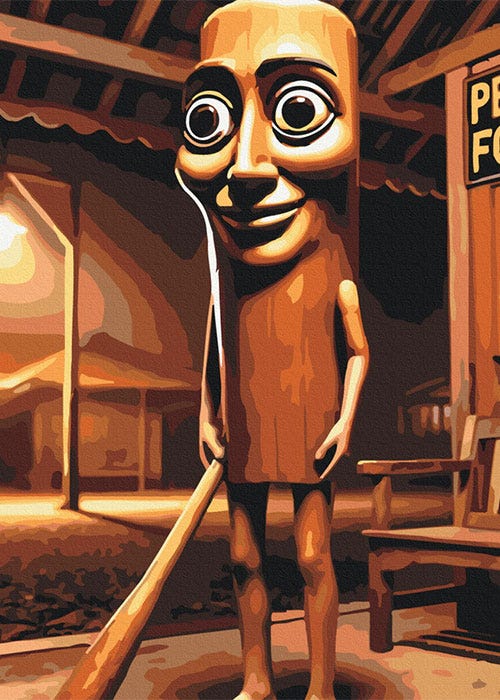
don't let your brain rot
On the subway headed into the city one day, I pulled out my phone and asked chat (ChatGPT) where I should take my visiting friends for lunch. Later that evening, on the subway ride home, I was scrolling again.
I had been doing this all day. I consulted chat for every decision. I scrolled my feed during every gap in conversation. When we got back home, one of my friends said what he’d apparently been thinking for hours: “You’re fully brainrotted.”
I was defensive and disagreed at first. But as I gave it more thought, I realized he was right.
I finished undergrad before the rise of ChatGPT and short-form content. In terms of having a fully functioning, active mind, I was on the last flight out of Saigon. Still, only a few years on, I can feel my brain slowly rotting.
AI and short-form content may seem unrelated. One is a productivity tool you use at a desk; the other is a feed you swipe through on the toilet. However, their coinciding rises are targeting the same thing: the ability to think independently and critically. It is the defining cognitive risk of our generation.
René Descartes famously wrote: “I think, therefore I am.” The act of thinking proves our existence and what separates us from all other living beings. It is the master skill. Every other human capability ladders up to it. AI and short-form content are destroying our ability to do this.
Most people I speak to about this know something is off, but they feel it is inevitable: that we’re all on a one-way flight to rotted brains and there’s nothing we can do about it. I thought the same thing.
On the AI front, the models have become increasingly capable at an astonishing rate. The latest models (Claude Fable 5, Opus 4.8, and ChatGPT 5.5) can conduct complex analyses, write succinct code, and build financial models faster and better than most humans. The models have improved to a point where I can rely on them for more and more of my work. As a student this past year, my first instinct for any assignment became to figure out how to get AI to help me with it (do it for me, if I’m being honest). Reading cases, writing essays, and building Excel models: these became tasks for my great friends Claude and Chat.
I don’t think this is entirely horrible. I’ve spent years (in undergrad and then as a consultant) building these skills (reading, writing, complex analysis, building excel models). At this point, I have developed judgment and know what good output looks like. The AI tools have become my diligent interns: they get the work done, and I review and direct. Still, doing this consistently has a cost. Reading, writing, and thinking hard are mental exercises. If you don’t do them regularly, those muscles atrophy.
MIT researchers put numbers to this recently. In a study measuring brain activity during essay writing, participants who used AI showed the weakest neural connectivity of any group, and it dropped further with each session. Over 80% of those who used AI couldn’t quote a single line from the essay they had just written. The researchers called it “cognitive debt”: outsourcing mental effort weakens your capacity to think, and the effect persists even after you stop using the tool.
Short-form content attacks your ability to think through a different avenue. A meta-analysis of nearly 100,000 people found that frequent users of short-form video platforms scored lower in attention span, focus, and working memory: the exact skills you need to read, study, and think through hard problems. The algorithm’s primary effect is the dopamine hit it gives you every few seconds, which trains your brain to expect constant stimulation. Sustained focus starts to feel boring by comparison.
The algorithm’s secondary effect gets much less attention.
Walk around New York on a weekend, and you will notice how similar everyone looks. The Sambas. The “New York or Nowhere” hats. The insane lines outside L’Industrie, Café Paradiso, Caffé Panna, and whichever froyo place is popping on TikTok that week. You start to notice that most people you see are actually quite similar. Hundreds, if not thousands, of people have all arrived at the same conclusion independently. I noticed this most clearly when several different groups of friends visited me in the city over the past year. Nearly all of them showed up with the same itinerary. They’d all gotten it off TikTok.
When the same algorithm curates the same stream for millions of people, everyone converges. Same sense of humor. Same aesthetic sensibility. Same opinions on topics. You don’t just lose focus. You lose the sense that your perspective was ever really your own. The feed doesn’t just distract you. It gradually replaces you.
The clothes and the cafés are the most visible symptoms. However, if the algorithm can decide what a million people wear and where they eat, it can also decide what they believe. The same convergence is happening on the things that actually matter: how people think about religion, relationships, and politics. This is harder to see because a hat or a line outside a cafe is obvious, and a worldview is not, and because no one experiences it as being told what to think. Each conclusion arrives feeling like your own.
Neil Postman saw this coming in 1985. In Amusing Ourselves to Death, he argued that a culture doesn’t get destroyed by what it fears, but by what it loves. His subject was television, and he warned of a society kept docile not by force but by pleasure, too entertained to notice it had stopped thinking. Postman wrote that before the internet, before the smartphone, and before a feed engineered to deliver a dopamine hit every few seconds.
E.M. Forster went further in his early 20th-century story The Machine Stops, where people live alone in identical cells, and every idea and image is piped in through a single machine they’ve stopped questioning, until first-hand experience feels vulgar and original thought quietly dies out. Nobody rebels because The Machine feels like comfort rather than captivity. That is the part that should worry you. From the inside, colonization doesn’t feel like an invasion. It feels like having good taste.
The two technologies are working together to deliver a fatal blow to our cognitive abilities. AI offloads your thinking, and short-form content colonizes it. The casualty in both cases is the same: the capacity to think, feel, and decide for yourself.
I know this sounds very cynical and doomer-y. Every generation has panicked about a new technology destroying young minds. Socrates thought writing would make people forget how to think (why memorize anything when you can just look it up?). People said the same about the printing press, calculators, and Google. The worried adults have thus far always been wrong. Younger generations have adapted to new technologies, and humanity has continued to progress.
So why should this time be different?
The calculator objection is the best analogy for this argument. Calculators made us worse at arithmetic. Nobody thinks that was a catastrophe because we offloaded a sub-skill and freed up mental bandwidth for higher-order work. Some will argue that AI and short-form content are doing the same thing: making us worse at some tasks while freeing us for better ones.
However, the calculator offloaded arithmetic, which is a single skill near the bottom of the cognitive stack. AI and short-form content, on the other hand, are offloading thinking itself: the master skill, the one that all other capabilities depend on. There is no higher-order work to move up to. When Descartes said “I think, therefore I am,” he was identifying the one irreducibly human ability: the capacity to think. We are now gleefully outsourcing it.
I’m not saying you should be a Luddite and avoid AI and short-form content. Quite the opposite, actually - anyone who has spent time around me knows I am a big proponent of both. I think the most important question to answer is: are you using these tools to replace your thinking, or to extend it?
Extending your thinking with AI looks like the following: You start with your own draft or outline of an essay, then hand it to the AI to attack: find the weak arguments, steelman the opposition, and point out what you’re missing. You read a hard book with and use AI as a reading companion, you use it to explain difficult concepts you don’t understand, and connect ideas you’d never have linked on your own. You build the side project you previously didn’t have the skill or time for, like a personal website. The common thread is that you think first, and the tool sharpens what’s already there. Replacing your thinking is the inverse: the tool goes first, and you sign off on whatever it hands back.
I struggled to read and write consistently after starting my consulting job. Now, using an AI system I built for myself, I read and write every week.
The same logic applies to short-form content. The test is whether you’re consuming to produce. If you scroll to learn a skill or to find material for something you’re making, you’re awake while you scroll, which is why creators and marketers who are chronically online tend to be fine. If you’re not making anything, get off it: use Brick, Opal, Screen Time limits, whatever actually works for you. The worst place to be is the middle, where you’re not online enough to benefit but still too online to think straight.
I realized I fell into the middle category and decided to delete my Instagram. That didn’t last very long (less than a month), and I bought a Brick instead. It has been helpful, although I find it difficult to stay consistent with it. I feel as though I’m generally trending in the right direction. It’s a work in progress, but as the idiom goes: a problem well defined is a problem half solved.
Remember that the brain is a muscle. If you don’t exercise it consistently, it will atrophy.
Wake up. Delete your Instagram. Go outside. Read a book. Don’t let your brain rot.